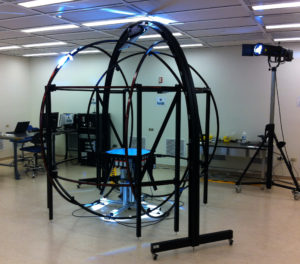
HSFL has acquired a state-of-the-art ADCS Test Facility for testing small satellites. The facility was built by Astro-und Feinwerktechnik Adlershof GmbH (AFW), or Astrofein for short, in Germany and was installed in February 2014 in the HSFL 10,000-class clean room. With the HSFL ADCS Test Facility, a complete end-to-end verification of ADCS systems for small satellite satellites can be executed with great accuracy. The facility permits the execution of complete, dynamic system level testing instead of the typical static Hardware-in-the-Loop (HIL) or Software-in-the-loop (SIL) simulations.
In its current configuration, the ADCS Test Facility is capable of testing small satellites within the range of 50 kg to 100 kg with nominal moments of inertia of 2.5 kg*m2 in the X, Y directions and 4 kg*m2 in the Z direction (changes to the inertia properties can be made to accommodate the design specifications of the satellite being tested). The range of testable inertias is from nominal 2.5 kg*m2 to 30 kg*m2. The interface platform installed on the top of the air bearing is 600 mm x 600 mm with a 100 mm, M4 bolt pattern. The overall dimensions of the test bed (including the coils and sun simulator) are approximately 3110 mm x 3500 mm x 3800 mm. HSFL is currently looking into a new platform configuration that will allow the testing of satellites with less than 2.5 kg*m2, including CubeSats.
The air bearing has a very low disturbance torque, less than 10-5 N*m. The platform is capable of rotating 360° about the vertical axis and approx. 20° in the roll and pitch axis for essentially 3 degrees of freedom (3DoF) rotation capability as experienced in space. Its safety mechanism prevents the air-bearing hemisphere from collapsing in case of a power failure or other unforeseen circumstances. The center of gravity (CoG) of the platform including the ADCS system is calibrated using an integrated linear motor mass system installed on the platform. The platform also has an integrated 24 V DC (unregulated), 400 Wh power source for wireless operation of the system under test.
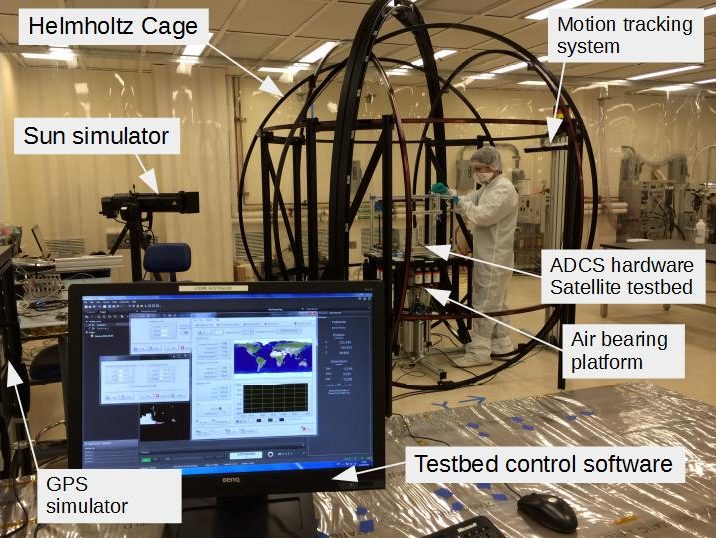 The ADCS Test Facility is remotely controlled by software for calibration and simulation runs:
- The Magnetic field coils can be calibrated and then set statically or dynamically as it would be in the case of a propagated orbit test
- The Center of Gravity calibration system is operated via Wi-Fi
- The Light intensity of the lamp is controlled by an intensity indicator
- The GPS simulator software can either replay a pre-configured orbit or dynamically receive the orbital position from another source
HSFL developed a software interface with Astrofein such that almost any parameter of the ADCS Test Facility can be controlled using third-party software and more specifically from the Comprehensive Open-architecture Solution for Mission Operations Systems (COSMOS) that has been developed at HSFL. COSMOS is the main software used for HSFL mission operations, ground stations, flight software and simulations.
Another improvement made by HSFL to the ADCS Test Facility is the addition of an Optitrack Motion Capture System using three near-IR cameras. This motion detection system uses IR motion trackers and is capable of determining the absolute attitude of the platform within 0.1º or better in the three axis. The attitude determination accuracy can be improved with the acquisition of more motion capture cameras.
The following are the multiple ADCS Test Facility simulators that are remotely controlled by software:
- Earth-magnetic-field simulator. This is a Helmholtz-coil system that consists of 3 x 2 air-core coils, one coil pair per coordinate axis. This makes a homogeneous magnetic field in the center of the chamber and makes it possible to orient the magnetic vector in any direction. The generation of the magnetic vector (direction and magnitude) can be controlled manually or automatically using the ADCS Test Facility operations software. This permits the automatic generation of magnetic fields as experienced in orbit. The intensity of the Magnetic Field can go up to +/-200,000 nT with an accuracy of <1% in the center and <10% within a 90 cm3 volume around the center.
- Multi-GNSS Signal Generator (GPS Simulator). Based on the SPIRENT GSS 6700 system. It simulates a GPS constellation to up to 12 satellites/channels on the L1 band. This capability brings flexible scenario generation including custom defined orbit simulation, antenna patterns, atmospheric effects, control of the GPS constellation, terrain obscuration, error models, etc.
- Sun Simulator. 50,000 lux homogeneous illumination may be provided anywhere on the upper-hemisphere of the ADCS Test Facility platform as a circular area of Ø500 mm. The simulator consists of a 575 W metal halide (HMI) lamp and a reflector mounted to a movable assembly. The reflector prevents overheating of the object under test while retaining the same illumination performance. The lamp’s luminous flux may be adjusted from 30% to 100%.
The ADCS Test Facility accelerates the development and validation of new ADCS hardware and software technologies for actively controlled small satellites including CubeSats. It is not only an ADCS testing platform, but it can also be used as a research and development platform for attitude hardware and software. Examples of interesting activities include testing of new software ideas, failure detection isolation and recovery (FDIR) algorithms and formation flying algorithms in synchronicity with other test beds.
Video
See the testbed in action
Education
ADCS Test Facility – EDU
The Attitude Determination and Control Test Facility - EDU is an on-going project and has been built up and used in several of our student projects and Space Grant Fellowship projects. This test bed allows attitude determination and control algorithms to be written and tested in a simulated magnetic and near frictionless environment.
The test bed combines 3 student-built parts:
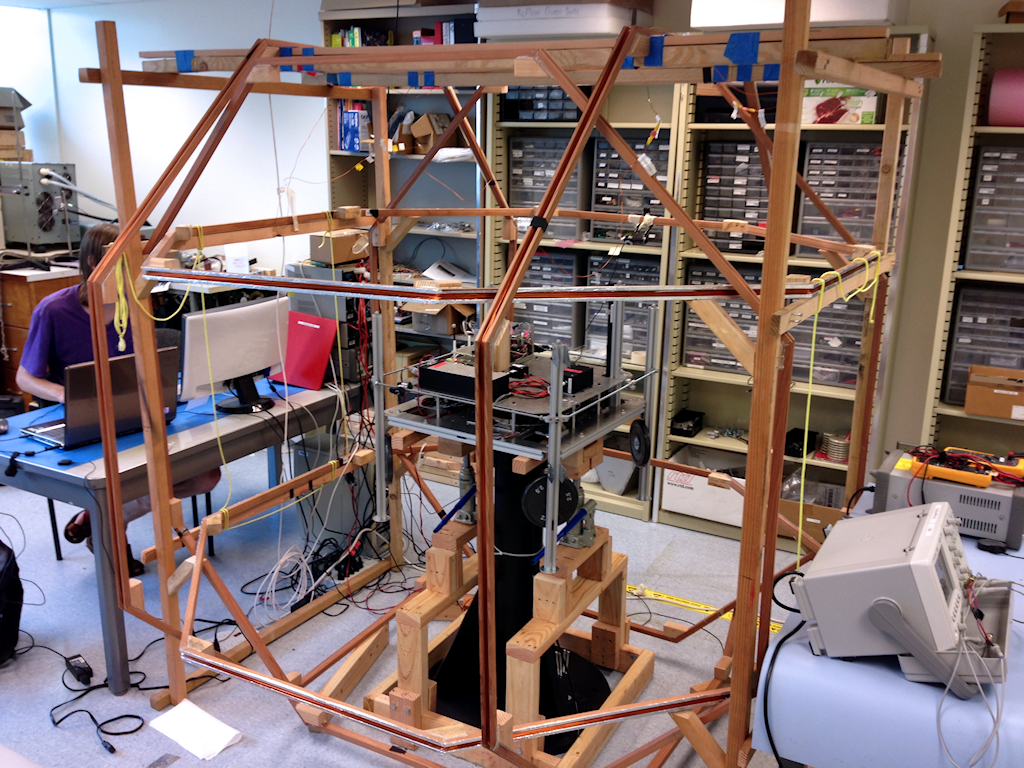
Helmholtz Cage
This cage allows us to tune and manipulate the magnetic field within its volume. One use is to effectively cancel out the Earth's magnetic field for tuning and characterization of sensors. The magnetic field can be easily increased to three times the Earth's magnetic field to greatly increase the torque provided by magnetic attitude actuators.
Test Platform
Any sensors, actuators, and control pieces used on in the test bed must be put on a platform. After final parts placement and securing wiring, the platform can then be neutrally balanced to allow for 3-axis attitude control. This is often a tedious and time consuming process, but provides for the most flexibility in attitude control options. We plan to have a future student project to automatically balance the platform, thus simplifying modifications.
Hemispherical Air Bearing
Our air bearing is a highly accurate, near friction-free precision instrument. Spherical air bearings are commonly used for zero-g satellite research, and they have also been used in systems for precision chip bonding and optical alignment. This bearing is capable of providing excellent load capacity and stiffness while allowing three axes of inherently frictionless rotational motion. Its features include:
- Freedom of rotation in 3 directions
- Center of rotation stability of ±5 millionths of an inch
- Range of motion up to +/- 45 degrees in two axes, 360 degrees along third axis
- Load capacity from 1 lb to 450 lbs
- Operating pressure from 10 psi to 90 psi
- Constructed out of black hard-coat Anodized Aluminum
The combination of these three items allow us to perform attitude control testing in an environment which simulates operation in space. This test bed will be continuously upgraded as more students pass on lessons learned, and new students advance the implementation.
Building on this student test bed, HSFL installed the professional ADCS Test Facility described above in its clean room in 2014, for satellites undergoing final flight validation.